Experienced print service providers (PSPs) all know that print production bottlenecks can happen anywhere in the workflow. They also change when staff, equipment, and space are added or lost. Bottlenecks are important to understand because they set the pace for revenue and profit. In this article, we look at the common ones most PSPs know and more importantly, the hidden ones that are often overlooked.

Familiar Print Production Bottlenecks
In our experience working with hundreds of printers, we see several bottlenecks that are widely known.
Problems with file preflight tops the list. This means that files arrive with missing fonts or RGB images. Low-res images and effects are another issue. For example, Illustrator raster effects are often left at a default 72 dpi.
No bleed or insufficient bleed is another issue. The wrong trim sizes, or inconsistent trim sizes, can happen when corrections are made by submitting single-page revisions rather than the whole file. In all cases, the job stalls before it ever reaches a plate.
Client proofing and approval delays are another typical bottleneck that can disrupt a schedule.
When it gets to the press, makeready, plate production, ink mixing, and color matching can jam up the workflow.
At the bindery and finishing end of things, folding, cutting, laminating, saddle stitching and other binding often backs up behind fast presses.
Special substrate and consumable availability can be added to the list. But these are easier to overcome since lead times are usually known ahead of time.
Hidden Print Production Bottlenecks
The “hidden” bottlenecks listed below may not be obvious until someone steps back and looks at the big workflow picture. Despite their unseen nature, they’re the type of blockages that affect the overall direction and profitability of a print service provider.
The Job Ticket
One such constraint is the job ticket system. How well is information handed off as the job moves through departments? Whenever there is incomplete or ambiguous information, it raises questions, stops the process, and slows the workflow.
And if a lot of questions tend to pop up in one area, it’s easy for a manager to blame the wrong area. For example, if the pressroom has frequent questions, they might take the blame for the blockage when in fact the ticketing system is to blame. Or maybe it’s a CSR or salesperson who doesn’t get all the details before submitting a job.
Makeready Time
Let’s say the average makeready time looks good, so you think all is well. The bottleneck here is hidden in the variations in time. If the spread in makeready times is wide, it pays to look at the outliers, those that take much longer than average. Understanding and eliminating a few of these can decrease the average setup times. But the only way to see them is to measure the variance as well as the average.
Scheduling
Scheduling can be another barrier to an optimized workflow. For example, let’s say jobs are produced in the order they arrived. It might be better to use a production sequence that minimizes makereadies and still meets deadlines. Or it might be possible to do gang runs.
Queue Time
Queue time tells how long a job is waiting at a station before it starts processing. It’s easy to spot a machine or operator that always has a lot of work-in-process piling up in front of them. You can actually see it on the shop floor. But this doesn’t tell the whole story.
For example, say that work routinely piles up in front of the folding machines. So the company adds extra shifts, but the queue time remains about the same. This could mean that the real culprit is in the scheduling. Or it might mean that automation tools are needed in the folding department.
Queue time helps to ask more and better questions. It helps to spot trends in a workflow. It helps to measure if a solution is reducing queue time.
Rework and Waste
When rework and waste aren’t measured and tracked, it gets hidden away as part of normal production. When the reasons for rework are known they can be fixed. If spoilage is measured and tracked, it can be reduced.
Knowledge Concentration
Knowledge and skills limited to one person in the shop is a people bottleneck. Unfortunately, it’s also pretty common because these days since it’s hard to find skilled people who will stay.
For example, there might be just one person who can run a saddle stitcher, an old press, or a die cutter. The work moves according to their availability and schedule. Sick days and vacations create instant choke points.
One of anything in business is almost never a good thing. It creates a single point of failure. A backup, either internal or external, gets rid of this issue.
Cross-training and strategic hiring are some internal solutions. Having external trade printing vendors like WTP is another way to back you up on skills shortages.
Material Staging
This can be a huge bottleneck, especially when high-volume jobs hit the shop floor, or when a higher-than-normal number of jobs are in process. It can repeatedly stop production in its tracks as staff takes time to move work-in-process to and from machines and staging areas.
A good example of the importance of staging is from J.S. McCarthy Packaging + Print, who recently set a world record for folding carton production. They produced 569,220 sellable sheets in 30 hours, 26 minutes. (That’s an average of about 19,000 sheets of 18 pt. board per hour!) A key to this record, according to Printing Impressions, was that their teams "stayed aligned on setup, staging, and material flow to keep the press running consistently at high speeds."
Of course you don’t need to be producing at that scale to think about material staging. But good material staging can help you break your own internal records.
Some clues that staging is a problem include operators spending time looking for job components including paper, ink, plates, a job ticket, or the work itself.
One other factor in material staging is drying or curing time. If it’s not considered ahead of time, it can slow the flow.
The Front Office
Order entry, estimating, production, and customer service are areas for potential production congestion. Some questions that can highlight future problems:
Are responsibilities clearly defined?
When a client calls with a question or problem, does the CSR know who to talk to and what to do?
Is there a lot of manual data entry or re-entry in different software that could be streamlined or automated?
Is there a system for following up with clients for jobs awaiting approval?
What happens when a client file has issues that need fixing?
How WTP Can Relieve Print Production Bottlenecks
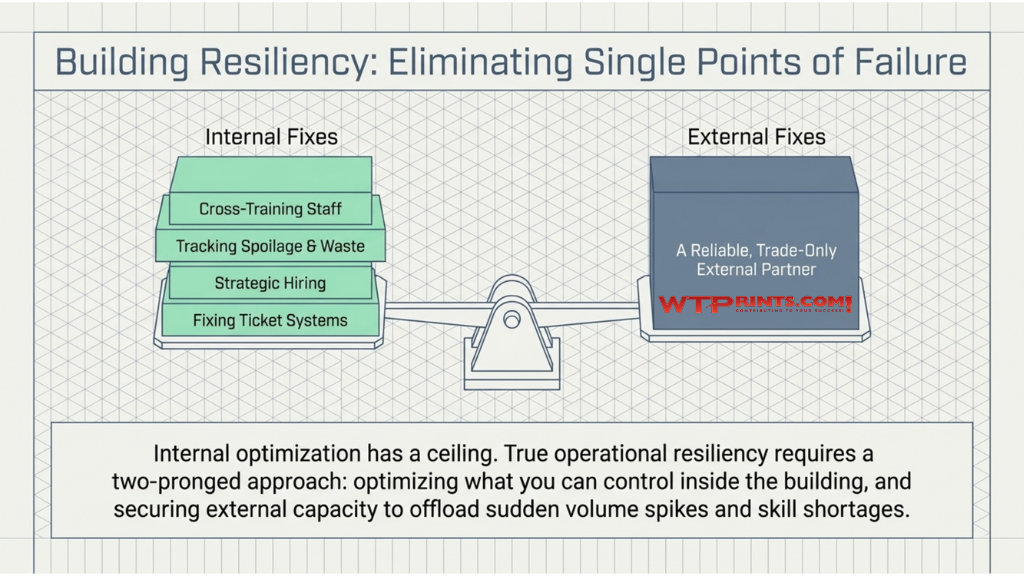
Wherever there is “one” of anything critical in your company, WTP can act as an equipment and operator backup. We also relieve scheduling and production overload issues in these areas:
- Pre-Press
- Press Work - Offset and Digital
- Folding, Cutting, and Other Bindery Work
- Saddle Stitching
- Short Run Perfect Binding
- Mailing and Fulfillment
If you’re facing a print production bottleneck, call us at 559-251-8595. We’ll help with the current problem and can strategize about how to prevent them going forward.
Additional Resources to Help with Production Bottlenecks
Want a quick assessment on the efficiency of your printing operation?
Check out our Efficiency Assessment for Print Service Providers. It only takes about 5 minutes and will give you new insight on efficiency.
Also, take a look at Print Productivity vs. Efficiency - A New Way to Think About Output?
It can give you a new perspective on how to think about productivity and output.